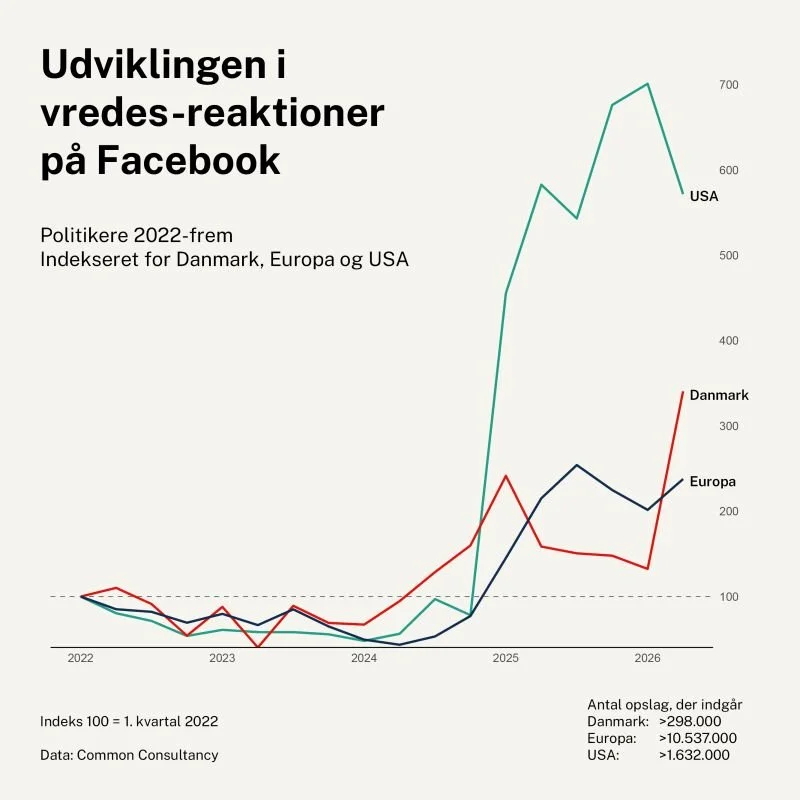
Anger on Facebook: what our data shows
Common Consultancy has tracked reactions to politicians' Facebook posts since 2022. The pattern is clear: anger has become the reaction that travels furthest.
In Q1 2022, a Danish politician's post received 7.8 angry reactions on average. That figure fell for several years, then rose sharply from early 2025, as a new and angrier political climate took hold in the United States. The shift spread to Europe and Denmark. By Q2 2026, the average Danish political post received 3.4 times as many angry reactions as in 2022.
Algorithms don't just change what we see. They change what we write. When angry reactions and outraged comments spread a post, we learn to write posts that provoke them, even when we could have written something many people would want to share.
Tech companies did not make us angry. But their algorithms have made anger an effective driver of reach.
Index 100 = Q1 2022. Based on more than 298,000 posts from Danish politicians, 10.5 million from European politicians and 1.6 million from US politicians. Source: Common Consultancy.